
PUR Hot Melt Dot Bonding Technology:The Complete Guide to Seamless Lingerie Manufacturing in 2026
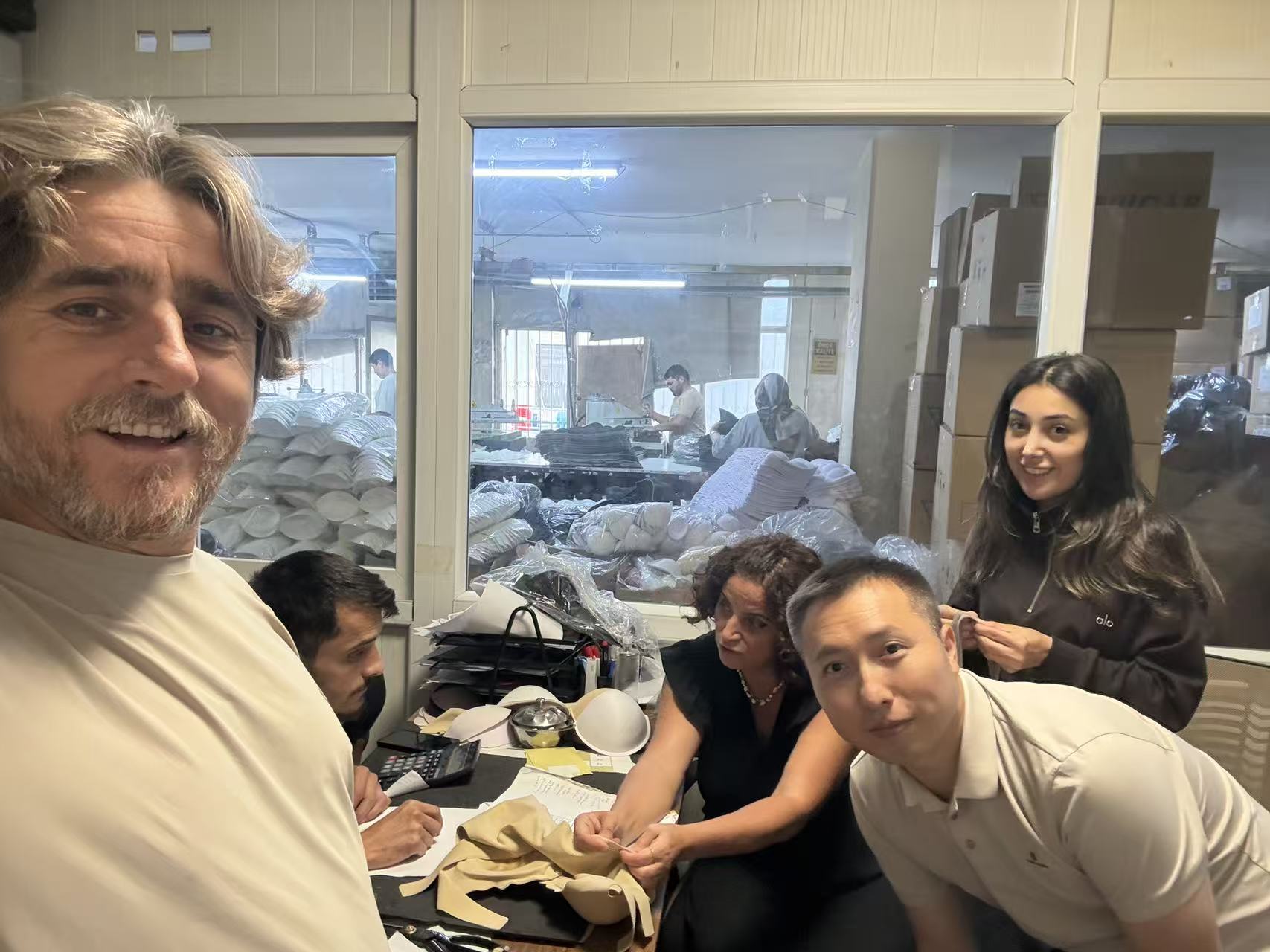
Masbond technical team discussing seamless lingerie production solutions on-site at a Turkish intimate apparel factory workshop
Caption:Our technical team reviewing fabric samples and production workflows on-site at a Turkish intimate apparel factory,where real-world manufacturing challenges are solved face-to-face.
When we visit garment factories across Türkiye,Bangladesh,and Southeast Asia,one question comes up again and again:How can we upgrade our seamless lingerie production to meet rising quality demands while keeping costs competitive?
The answer increasingly points to one technology:PUR hot melt dot bonding.But what exactly is it,why are leading intimate apparel manufacturers adopting it,and how does visual dispensing technology change the game?
This guide covers everything you need to know—from core bonding principles to production optimization and future industry trends.
What Is PUR Hot Melt Dot Bonding?
PUR(Polyurethane Reactive)hot melt adhesive dot bonding is a process where precisely controlled micro dots of PUR adhesive are applied to fabric surfaces using automated dispensing equipment.The adhesive reacts with moisture in the air,creating a durable,flexible bond that maintains the fabric's natural stretch and hand feel.
Unlike traditional continuous glue coating,dot bonding applies adhesive only where structural support is needed—typically along bra cup edges,underbust bands,side seams,and necklines.This targeted approach delivers three critical outcomes:
-Minimal fabric stiffness in non-bonded areas
-Strong,long-lasting support exactly where the garment needs it
-Lightweight comfort that modern intimate apparel consumers demand
The process is widely used in seamless bras,bralettes,shapewear,athletic underwear,and medical compression garments.
Why Manufacturers Choose PUR Dot Bonding:5 Core Advantages
1.Superior Wash Durability
PUR adhesive forms a chemical cross-link after curing,creating a bond that withstands 50+home wash cycles without peeling,lifting,or hardening.This is essential for intimate apparel,where consumers expect garments to maintain shape and support through repeated laundering.
2.Soft,Skin-Friendly Hand Feel
Because PUR dots are applied in discrete patterns rather than solid layers,the fabric retains its natural elasticity and breathability.The result is a garment that feels soft against the skin—a key differentiator for premium lingerie brands.
3.Precise,Programmable Dot Patterns
Modern dispensing systems allow engineers to control:
-Dot diameter(typically 0.3–1.5 mm)
-Dot spacing and density
-Adhesive volume per dot
-Pattern geometry by garment style
This means support can be engineered into the garment with surgical precision—reinforcing high-tension zones while keeping comfort zones completely glue-free.
4.Clean,Efficient Production
PUR hot melt requires no solvent,no long drying tunnels,and produces virtually no adhesive waste.Factories report faster cycle times and lower defect rates compared to liquid adhesive or tape-based processes.
5.Compliance with Global Textile Standards
PUR adhesives are OEKO-TEX®Standard 100 certified and free of harmful substances,making them suitable for brands exporting to the EU,North America,and other regulated markets.
How Visual Dispensing Machine Technology Transforms Production
While PUR dot bonding itself is not new,the visual positioning dispensing machine represents a major leap forward in production accuracy and efficiency.
Traditional dispensing systems rely on manual fabric alignment—operators must position each fabric piece precisely under the dispensing nozzle.Even small misalignments lead to off-pattern dots,wasted material,and rejected garments.
A visual dispensing machine solves this with an integrated camera system that:
✅Automatically detects fabric position and orientation in real time
✅Compensates for fabric stretch and deformation caused by cutting and handling
✅Adjusts the dispensing path dynamically before each dot is applied
✅Reduces operator dependency and lowers training requirements
The impact on factory operations is measurable:
-Lower defect rates—fewer off-pattern rejects
-Faster setup—no manual alignment jigs for each style
-Higher throughput—operators can load more pieces per hour
-Consistent quality across shifts and operators
For factories producing multiple bra styles per week—a common scenario in fast-fashion intimate apparel manufacturing—the ability to switch patterns quickly without re-tooling is a significant competitive advantage.
Industry Trends:What's Next for Seamless Intimate Apparel Bonding?
Based on our on-site consultations with garment factories across three continents,we see four key trends shaping the next 3–5 years:
Trend 1:Digital Pattern Customization at Scale
Brands are increasingly demanding differentiated lingerie styles with short production runs.PUR dot bonding,combined with digital pattern libraries,allows factories to develop new styles in days rather than weeks—no custom moulds required.
Trend 2:Sustainability-Driven Process Shifts
Solvent-free PUR processes align with the textile industry's broader move toward greener manufacturing.Expect more brands to specify PUR bonding in their sustainability requirements.
Trend 3:Integration with Automated Cutting Lines
Leading factories are combining automatic fabric cutters with visual dispensing systems to create semi-automated seamless production cells—reducing both labour dependency and human error.
Trend 4:Rising Demand for Local Technical Support
As we've seen from our factory visits,equipment performance ultimately depends on local technical support.Factories are prioritizing suppliers who offer on-site training,sample testing,and responsive after-sales service—not just machines.
Why On-Site Technical Consultation Matters
The photo at the top of this article was taken during a visit to a Turkish intimate apparel factory.Our team sat down with the production managers,examined their existing fabrics,reviewed their workflow,and analyzed the defects from their trial runs—all in the workshop,where the real production happens.
Specification sheets and video demos can show what a machine can do.But they cannot tell you:
-How your specific fabric type behaves with PUR adhesive
-What dot pattern works best for your bra cup design
-How to integrate dispensing into your existing production line
-What quality adjustments are needed for your target market's standards
This is why we believe the most effective equipment partnerships begin on the factory floor,not in a showroom.
Frequently Asked Questions
Q:What types of fabric are compatible with PUR dot bonding?
A:PUR adhesive works well with nylon/spandex blends,polyester,microfiber,and most common intimate apparel fabrics.We recommend sample testing for novel composite materials.
Q:How long does it take to train operators on a visual dispensing machine?
A:Most operators become fully productive within 3–5 days of hands-on training.The visual positioning system significantly reduces the learning curve compared to manual alignment systems.
Q:Can PUR dot bonding replace stitching for all lingerie applications?
A:PUR dot bonding is ideal for edge bonding,seam reinforcement,and structural support in seamless garments.It complements—rather than completely replaces—traditional stitching for specific high-stress applications.
Q:What is the typical ROI timeline for a visual dispensing machine investment?
A:Based on factory feedback,most operations recover their investment within 12–18 months through reduced defect rates,lower labour costs,and increased production capacity.Exact ROI depends on current production volume and defect rates.
Ready to Upgrade Your Seamless Lingerie Production?
At Masbond,we don't just sell equipment.We work with your team on-site,test your fabrics,and build a bonding solution that fits your specific production goals.
Whether you're exploring PUR dot bonding for the first time or looking to upgrade to visual dispensing technology,our engineering team is ready to visit your facility and provide a detailed production assessment.
Contact us today to schedule a free on-site consultation or fabric sample testing.
 WhatsApp
 Email
Email
 +0086 13973161941